$27 · Instant Download
Trevor Lawrence Jr. · TrevBeats Multimedia
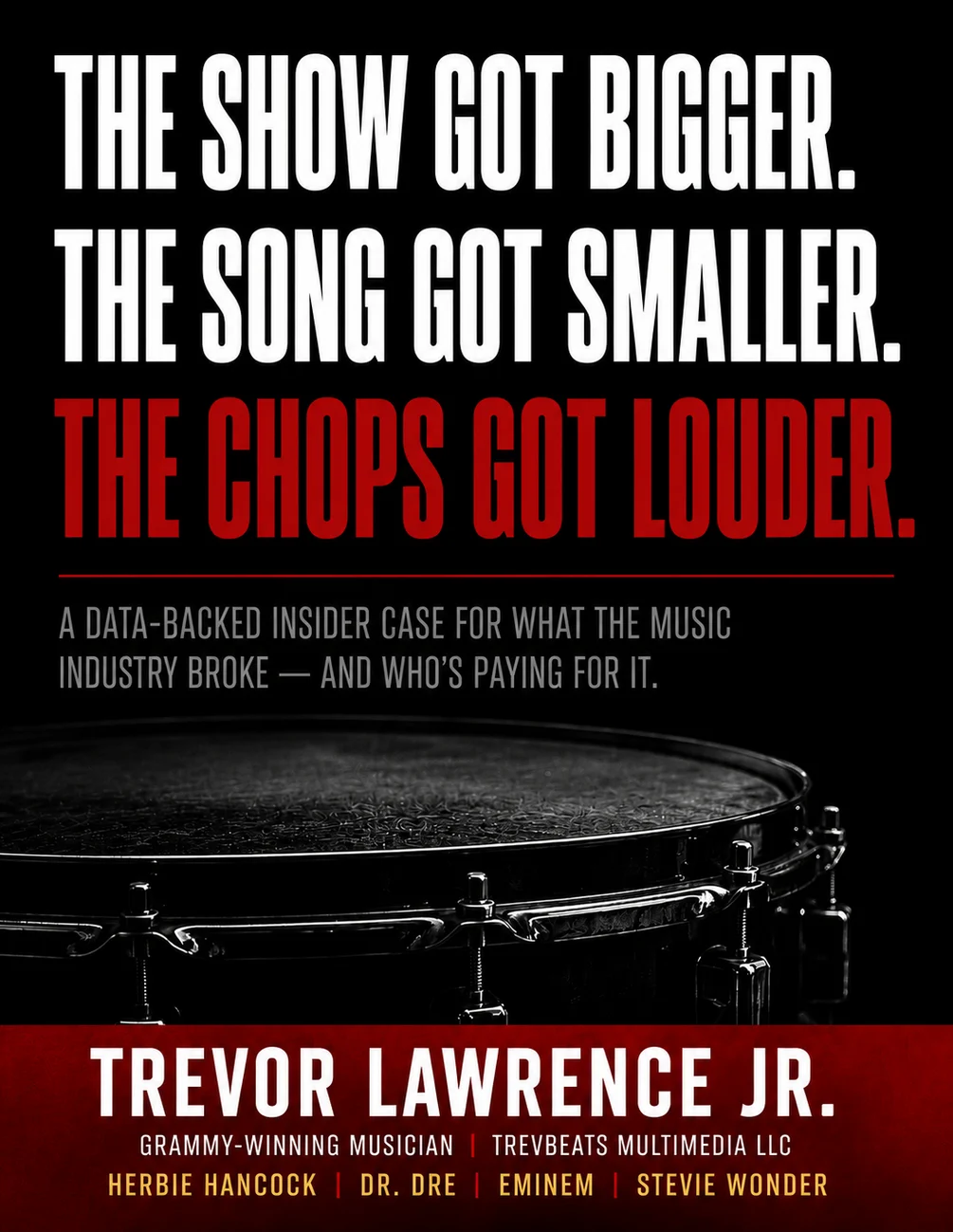
A Data-Backed Insider Case for What the Music Industry Broke — and Who's Paying for It.
The drummer used to be the heartbeat. Now, in too many cases, we're the defibrillator. 31 pages of receipts that prove the connection between the show getting bigger, the song getting smaller, and why the chops have never been louder.
The Case
Three data trends that look separate — until you realize they're the same story told three different ways.
In the 1970s, the average number of credited songwriters on a number-one hit was 1.7. By the 2020s, that number is 6.8. Drake's "In My Feelings" had 14 writers. Beyoncé's "Heated" had 18. That's not collaboration — that's a committee manufacturing a product.
In the 1970s, 95% of the top-grossing tours featured a full live drummer. By the 2020s, that number is 38%. The drummer didn't get replaced because the music got simpler. The drummer got replaced because the show got bigger than the song.
As live drummers declined, ticket prices went the other direction — up 655% in real terms since the 1970s. You're paying more for shows that have less live music in them. That's not a coincidence. That's the Chops Tax in action.
The Bad Tour cost Michael Jackson roughly $125,000 per night. Modern major tours run $2–3 million per show. The production budget didn't just grow — it became the product. When the song is hollow, the riser goes up.
Motown, Atlantic, and the great labels of the 1960s–80s ran artist development programs. They spent years building careers. Labels today find finished products and distribute them. The difference between developing an artist and manufacturing one is the difference between Stevie Wonder and a two-year viral cycle.
The central argument: for every point of songwriting depth an artist can't provide, the drummer compensates with another layer of complexity. The weaker the song, the louder the chops have to be. The riser goes up. The fills get bigger. Not because the drummer got better. Because the song got smaller.
What's Inside
Every chapter is built around actual data — not vibes, not nostalgia, not hot takes. If it's in here, there are receipts.
The golden era of James Brown, Michael Jackson, Earth Wind & Fire — when the drummer's job was to be invisible and devastating at the same time. What "pocket playing" actually means, and why Motown and Atlantic built careers instead of manufacturing products.
RIAA data: the industry hit $26.9B (inflation-adjusted) in 1999, collapsed to $7B by 2013 — a 74% drop — and recovered to $17.1B in 2023. Still only 63% of the 1999 peak in real terms. The economics of why everything changed.
Michael Jackson: 45+ year career. Stevie Wonder: 63+ years. Gotye: 810 million streams across two years, then 99.5% of his platform activity disappeared. "Viral doesn't build — it burns." The data on longevity, legacy, and what separates the two.
Labels shifted from finding artists to building products. The old way vs. the new way — documented. And the moment the drummer became part of the spectacle package rather than part of the band.
The two drumming jobs that now exist — and the Chops Tax that defines both. The direct correlation between songwriting dilution, production inflation, and drummer showmanship. The central argument, built from the data up.
$9.5B in worldwide top-100 tour grosses in 2024. Taylor Swift's Eras Tour alone: $2.08B. Live drummer presence in top-grossing tours by decade: 95% (1970s) → 82% (1980s) → 68% (1990s) → 52% (2000s) → 42% (2010s) → 38% (2020s). These numbers tell the whole story.
By The Numbers
About the Author
Music runs in my blood — literally. My mother Lynda Laurence was a member of The Supremes. My father Trevor Sr. performed with Stevie Wonder. My grandfather Ira Tucker won a Grammy with The Dixie Hummingbirds. I grew up around people who knew what a real song felt like from the inside.
I've played behind Bruno Mars, Eminem, Dr. Dre, Ed Sheeran, Alicia Keys, and Lionel Richie. I've sat behind the kit on tours running $2–3 million per show in production and watched engineers trigger pyrotechnics because the artist ran out of charisma in the third song. I've also been in rooms where James Brown's rhythm made 20,000 people stop thinking and start moving — with nothing but a groove.
This book is 31 pages of what you see from the best seat in the house. Not an opinion. The data — pulled, charted, and connected to prove what every drummer already feels but hasn't been able to say out loud.
10 Grammy Wins · 26 Grammy Nominations · Sessions with Dr. Dre, Eminem, Bruno Mars, Ed Sheeran, Alicia Keys, Lionel Richie · Inventor of the Istanbul Agop Clap Stack™ · Creator, The TrevBeats Show
Who This Is For
This report gives you the language and the data to prove it.
FAQ
31 pages. Data-backed. One-time $27. The music industry case you already suspected — now with receipts.
GET THE BOOK — $27